



The story of the Hilton family demonstrates that transferring wealth, transferring control of a business, and passing on a family legacy are three very different decisions. At first, it seemed that all three would follow the same path: a founder builds a hotel empire, his son takes over, and future generations carry the business forward. In the end, however, a large part of the family’s wealth was channelled into a philanthropic foundation, while the hotel group itself passed into the hands of external capital.
Conrad: the business as a source of wealth, the foundation as its future legacy
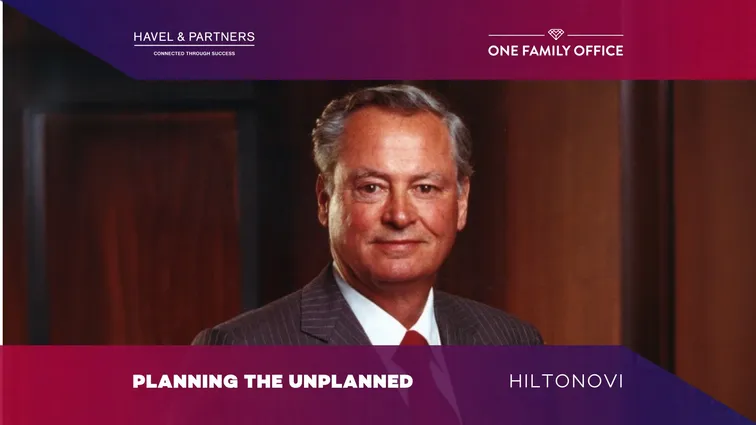
Conrad Hilton entered the hotel business in 1919 with the acquisition of the Mobley Hotel in Cisco, Texas. Over time, he built a hotel network whose name became an internationally recognised brand. From an early stage, however, his legacy had a second institutional pillar. In 1944, he established the Conrad N. Hilton Foundation.
Alongside the operating business, there was now an organisation with a distinctly different purpose. The hotel business was created to generate wealth; the foundation was established to use that wealth to alleviate human suffering. Conrad also reflected this vision in his final testament. Following his death in 1979, the foundation inherited a substantial part of his holdings in Hilton shares. According to the foundation, the value of this bequest was approximately $160 million.
From a succession-planning perspective, this was a decision with far-reaching consequences. Conrad did not want his wealth to serve merely as a private source of consumption for future generations. Instead, he intended the family’s wealth to continue through an institution whose mission would outlive its founder.
This approach, however, also created a degree of tension, as ownership of the company and control of the business gradually became separated.
Barron: the business successor who initially challenged his father’s legacy
Conrad’s son, Barron Hilton, assumed the leadership of the hotel group in 1966. He was therefore not simply an heir waiting to inherit wealth. He was also the entrepreneurial successor who led the group and continued to develop it.
Following Conrad’s death, a lengthy dispute arose over the structure of the estate, particularly regarding the ownership of Hilton shares and Barron’s entitlement to them. It is here that the Hilton story departs from the polished narrative of a smoothly continuing family dynasty. The founder had a philanthropic vision for the future of the family fortune. His son was expected to continue leading the business, but not as its majority owner. Conrad’s final will did not fully reconcile this divide.
From a family governance perspective, this is a particularly instructive moment. A legal document can determine who inherits wealth and who leads a business. What it cannot do, however, is create consensus on why such an arrangement is fair, who should bear responsibility for leading the business, and how that responsibility should be aligned with its economic benefits.
2007: the family ceases to shape the destiny of the hotel company
The next major turning point came with the sale of Hilton Hotels to Blackstone in 2007. The transaction was valued at approximately $26 billion.
The sale fundamentally changed the nature of the succession question. Until that point, the central issue had been who would own and control the hotel business. Following the sale, it was also possible to address the question how to manage capital that no longer needed to remain tied to a single family company or operating enterprise. The family consequently evolved from a family of hoteliers into a family of investors. The transaction enabled them to allocate the market, geopolitical, political and economic risks that had previously been concentrated in the operation of a global hotel chain, replacing them with the management of a balanced investment portfolio alongside a philanthropic agenda.
At the same time, the family name remained associated with one of the world’s most iconic hotel brands, even though the business itself was no longer owned by the Hilton family. The hotel company could continue to operate under the Hilton name without its future depending on whether the next generation of the family wished, or was able, to assume its leadership.
Barron’s turning point: most of the wealth was not to pass to future heirs
In the same year, Barron Hilton announced that 97% of his wealth would be bequeathed to the Conrad N. Hilton Foundation. At the time, in the announcement, his fortune was estimated at approximately $2.3 billion.
As part of the plan, around $1.2 billion of the proceeds from the sale of Hilton Hotels and Harrah’s was transferred into a charitable remainder unitrust, with the assets ultimately designated to pass to the foundation. This was therefore not simply an immediate transfer of the entire sum to the foundation, but rather a carefully structured philanthropic wealth-transfer arrangement.
This is where the story takes a remarkable turn. The son who had challenged his father’s estate arrangements after Conrad’s death ultimately came to embrace a similar philosophy regarding the long-term stewardship of family wealth.
Barron Hilton passed away in 2019. According to the foundation’s own history, his bequest increased the foundation’s capital from approximately $2.9 billion to $6.3 billion, making him the largest donor in its history. These figures relate to a different point in time than the estimate of Barron’s wealth in 2007 and therefore cannot be compared directly. It is nevertheless reasonable to conclude that Barron was highly successful in growing the family fortune through investment activity over the course of his lifetime.
Barron bequeathed the remaining 3 per cent of his estate to family members through family trusts, through which they could continue to invest or manage their own investment and business activities.
What, then, was passed on to the next generation?
With the transfer of wealth into the foundation, the family’s role did not end. Instead, its nature changed.
The descendants were no longer expected to be owners whose shares in the original wealth were diluted as it was divided among them. Rather, they could continue as people responsible for the mission of the institution (the foundation) that the family had created. And they also remained motivated to pursue their own business and investment activities.
The foundation’s public documents demonstrate the family’s continued involvement in the foundation’s board, including the existence of board internships for family members. Steven M. Hilton, Conrad’s grandson and Barron’s son, served for many years in the foundation’s management and later became chairman of its board.
What does the Hilton story tell us about family wealth?
The Hiltons are not a simple example of a family successfully keeping a business in the family’s hands across generations. Their story is more about the gradual separation of the business, the wealth, and the family’s mission.
Conrad built the business and gave his wealth a philanthropic direction. Barron assumed leadership of the company, grappled with his father’s estate structure, expanded the business and, following its sale, ultimately directed the vast majority of his own wealth towards the same purpose. Subsequent generations were given the opportunity to continue the institutional responsibility for that legacy while pursuing their own investment and business ambitions.
From a family governance perspective, this raises a practical question: what is it that should outlive the founder? Is it a specific business remaining under family control, the financial security of descendants, a shared pool of capital, or a purpose associated with the family name? Each answer requires a different arrangement.
In the end, the Hiltons preserved their family legacy primarily through an institution and the purpose it serves. A substantial part of the wealth ceased to be inherited as private wealth. What continues to be passed from one generation to the next is the opportunity, and the responsibility, to decide what purpose that wealth should serve.