



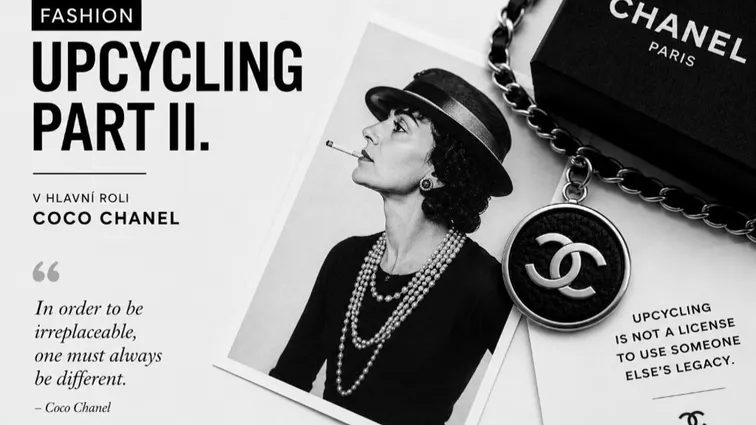

“In order to be irreplaceable, one must always be different.”
– Coco Chanel
Originality is one of the fundamental pillars of fashion.
But what happens when someone takes original components from CHANEL luxury products, turns them into jewellery, and starts selling them under their own brand?
Is it creativity? Sustainability? Or an infringement of CHANEL’s rights?
Following last year’s ruling involving Hermès, the French courts were once again confronted with a very similar question. And once again, the answer was unequivocal.
What was the case about?
The company Kamad Reworked created earrings, bracelets, necklaces, and other jewelry pieces using original buttons, buckles, and other components sourced from authentic CHANEL products. These components still bore the iconic CHANEL, COCO, and famous double‑C marks. The company then marketed the resulting products online as its own creations, built around the concept of fashion upcycling. It did not take long before CHANEL took the matter to court.
Kamad Reworked’s defence was fairly intuitive:
“Our business model is perfectly legitimate! Because:
▪ We use only genuine CHANEL components.
▪ We explicitly inform customers that these are not CHANEL products.
▪ We attach to every item a certificate confirming the authenticity of the components used.
▪ It is a creative and sustainable transformation of existing products.”
In other words – we neither conceal anything nor try to mislead anyone.
Yet that was not enough. Because CHANEL succeeded, and the Paris court ruled in its favour.
Why?
▪ “We are not Chanel” is not enough.
The defendant went to considerable lengths to explain that its products had no commercial connection with CHANEL. Its website featured a disclaimer, the company sold the products under its own brand, and customers even received certificates of authenticity.
None of this persuaded the court.
According to the judges, consumers still primarily perceive the famous CHANEL and double‑C signs, which remain the dominant feature of the newly created products.
▪ And, paradoxically, a certificate of authenticity can actually make things worse.
That’s probably what I found most interesting about the ruling. At first glance, it might seem that a certificate confirming the authenticity of the components used would solve the problem. However, the court saw it quite differently.
In its view, such a certificate could lead consumers to believe that the entire business model—built around original CHANEL components—was legally legitimate. For that very reason, the court classified the practice as misleading commercial practice.
A parallel with the Hermès case.
In the Hermès case, the Paris court was solving the dispute concerning the attachment of iconic Hermès silk scarves to denim jackets. The central issue there was copyright, specifically whether the principle of exhaustion of rights applies once an original product has been transformed.
I recently wrote about that case here ★ Hermés ★
In my view, the Chanel[1] ruling is a natural continuation of that line of reasoning. This time, however, the dispute did not primarily revolve around copyright. Instead, the focus shifted to trademarks.
The outcome is the same.
⚖ Just as in the Hermès case, the court rejected the argument that an environmental or artistic purpose could outweigh the rights of a luxury brand owner.
⚖ Where a newly created product continues to derive its appeal primarily from the reputation of a famous brand, simply labelling it as “upcycled” is not enough.
⚖ The principle of trademark exhaustion applies only to the further resale of the original product.
Summary?
The message from the French courts is clear: in the fashion industry, it is not enough that a product is new. Nor is it enough that it is environmental. If its value continues to rest primarily on the reputation of someone else’s prestigious brand, legal issues may arise.
And that brings me back to where we started. Coco once said: “Innovation! One cannot be forever innovating. I want to create classics.”
There is little doubt that she managed to do that. CHANEL has become a true classic—so iconic that its value and reputation continue to receive judicial protection, even decades later.
- [1] – Tribunal judiciaire de Paris, 21 May 2026, RG n° 25/00621 (Chanel v. Kamad Reworked).